
A CLOSER LOOK AT RESEARCH & SCIENCE
The body is electrical in ways most of us rarely think about — and for nearly a century, researchers have been curious about what gentle electromagnetic fields might do for it. Here's a look at that science: what's well established, what's still being explored, and how the Olylife THZ Tera P90 & P90+ models are built.
The Research Behind PEMF
A Quick Grounding Idea
Every cell in the body carries a small electrical charge. Nerves fire through electrical signals. The heartbeat is an electrical event before it's a mechanical one — an EKG simply reads that electricity. We are, quite literally, electrical beings as much as chemical ones.
PEMF — Pulsed Electromagnetic Field technology — grew out of a simple curiosity about that fact: if the body runs on subtle electrical activity, might gentle, pulsing fields interact with it in useful ways?
It's a question with real history. Electromagnetic therapies trace back through the 20th century, and today PEMF spans a genuine range — from FDA-cleared medical devices used in bone healing to the wellness platforms people bring into their homes.
One thing worth knowing from the start: PEMF isn't a single technology.
Devices vary enormously in strength, frequency, and how they deliver energy — some so gentle you'd never feel them, others quite noticeable. That variety is part of what makes the field so interesting, and it's why the research below is best read as a map of a broad territory rather than a verdict on one device.
THE CERTIFICATIONS
How the P90+ is made — and what its paperwork covers
Alongside the broader science, OlyLife provides documentation specific to the P90+. It's worth understanding what each piece covers, because these documents speak to how the device is built and tested — a different question from what the research above explores
-
Issued under the international CB Scheme, this certifies the P90+ against IEC 60335-1 and 60335-2-32— the safety standards for household electrical appliances and massage appliances, where it's classified as a "portable massager."
In short: it confirms the device met recognized electrical- safetystandards — shock protection, heating, insulation, mechanical soundness — in independent testing. It's a safety certificate, which is exactly what you'd want a device you use daily to have.
-
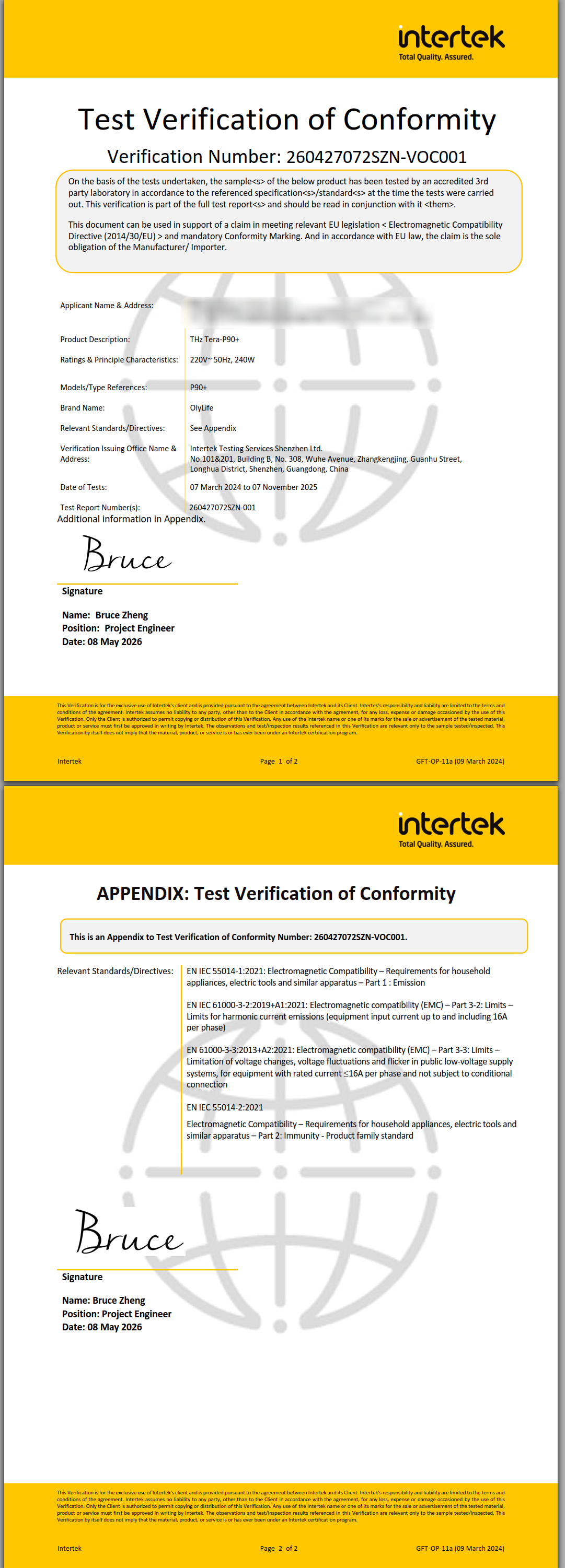
An electromagnetic-compatibility verification against EU standards, covering emissions, harmonic currents, voltage stability, and resistance to interference.
In short: a tested sample plays well with other electronics — it doesn't emit problematic interference and holds up under normal electromagnetic conditions. It's about how the device coexists with the world around it.
-
A Supplier's Declaration of Conformity confirming the device meets applicable FCC Part 15 requirements for electronic interference in the US.
In short: it meets US limits for electromagnetic interference. Like the EMC verification, it's about the device being a well-behaved piece of electronics — a baseline any home device should clear.


The signal, start to finish
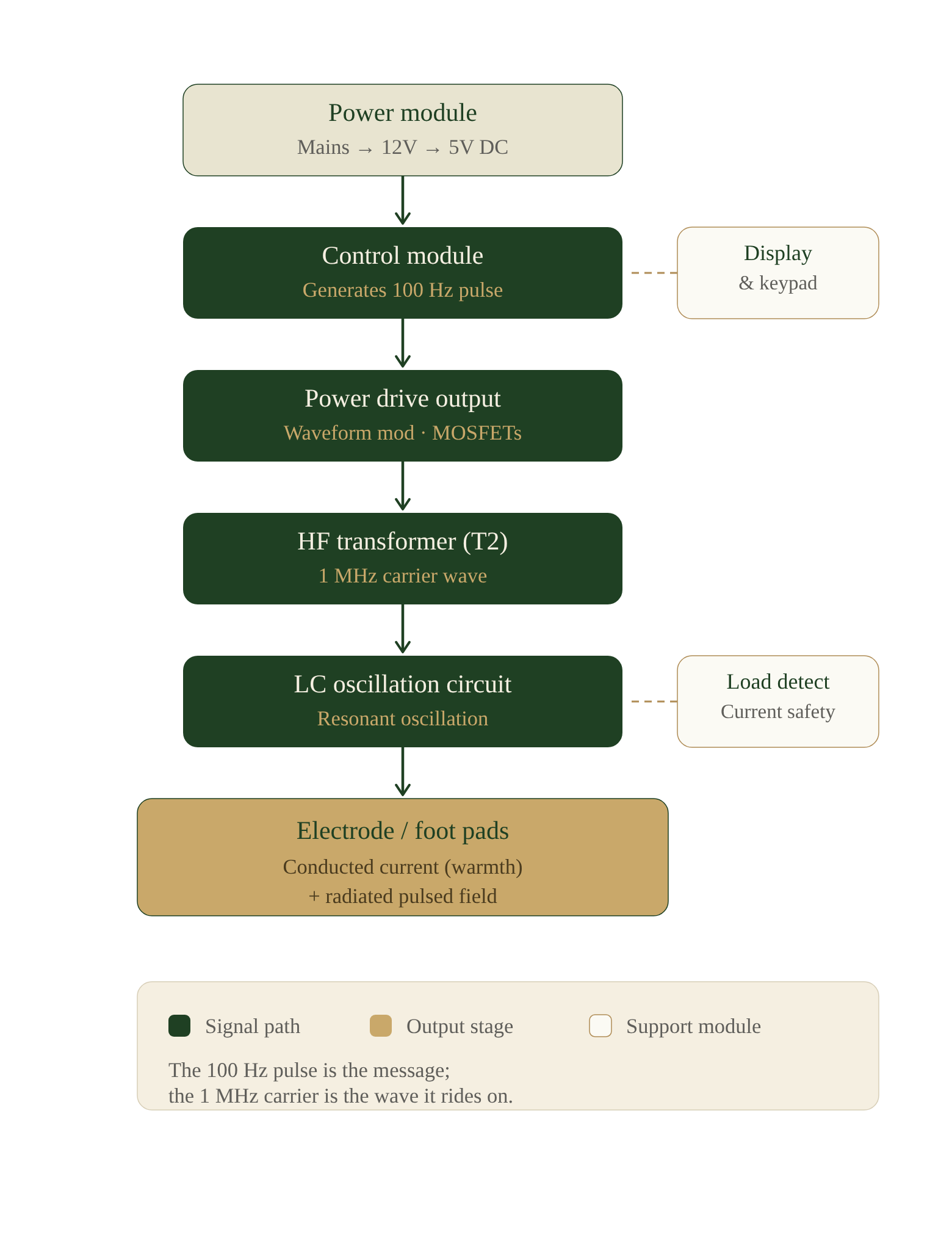
The signal travels top to bottom: household power is converted to safe low-voltage DC, the control module generates a 100 Hz pulse, a driver stage steps that pulse onto a 1 MHz carrier wave through a transformer, an LC circuit shapes it into a resonant oscillation, and the foot pads deliver the result. Two supporting modules sit to the side — the display and keypad, and a load-detection circuit that monitors current for safety.
Taken together, these verifications confirm something worth having: samples of the P90+ passed independent testing for electrical safety and electromagnetic compatibility. They speak to how the device is built and how safely it runs —
which is a foundation, and a good one to build a daily practice on.
A DEEPER LOOK UNDER THE HOOD
How the P90+ is designed
For the technically curious, the device's design is documented in a registered utility-model patent (CN 221557340 U). It offers a genuinely useful window into how the P90+ produces what a user feels. Here's the signal path from the wall outlet to the foot pads — and an honest look at what that design does and doesn't tell us.
WHAT EACH PART DOES
Power Module
Converts household mains power down to safe, regulated low-voltage DC (12V, then 5V) to run the electronics. The foundation everything else depends on.
Power Drive Ouput (MOSFETs)
Takes the low-power control signal and drives it at the power needed to produce a real output, shaping the waveform along the way
LC Oscillation Circuit
An inductor-capacitor circuit that creates a resonant electromagnetic oscillation — the part of the design responsible for the pulsed field.
WHAT SETS THIS DESIGN APART
Many conventional PEMF devices use coils to generate pulsed magnetic fields that extend from an applicator into the body. They do not require an electrical current to pass between contact points on the user.
The P90+ is designed differently. It requires direct contact with conductive footplates and produces a noticeable warming sensation during use. Based on the device’s contact-based operation and the technical information currently available, its user experience appears to involve several overlapping elements:
Contact-based electrical delivery — the device delivers an electrical signal through conductive plates in contact with the feet.
Electromagnetic activity — OlyLife describes the device as using PEMF-integrated technology, and the associated patent points to an internal LC oscillation circuit as the source of that electromagnetic activity. Independent measurements of the actual field output and waveform aren't something this page can speak to.
A warming component — many users notice warmth during a session, which is consistent with energy being delivered through a contact-based electrical system.
This contact-based design is meaningfully different from a conventional coil-based PEMF mat or applicator. It also helps explain why the P90+ tends to feel active rather than imperceptible: users may notice warmth, tingling, or a distinct sense that the device is operating.
Control module
The brain of the device. It generates a 100 Hz pulse — the slow rhythm that shapes the therapy — and takes input from the display and keypad.
High Frequency Transformer (T2)
Steps the signal up onto a 1 MHz carrier wave. This is the fast oscillation that carries the 100 Hz rhythm — think of the 100 Hz as the message and the 1 MHz as the wave it rides on.
Electrode / Footpads - Where it all reaches the body
The pads do two things at once: high-frequency current passes through the contact surface and through the feet, producing gentle warmth, while the circuit also generates a pulsed electromagnetic field.
Load-detection module (safety)
A quiet but important piece: it continuously monitors the current passing through the pads and feeds that back to the control module, helping keep output within a designed range. A genuine safety-engineering feature.
ANALOGY
The device works like a carefully managed radio station. The power module supplies safe electricity. The control module creates the 100 Hz message. The power-drive stage amplifies it. The transformer places that message onto a 1 MHz carrier wave. The LC circuit acts like a tuned antenna system, creating resonance while conditioning the output. The footpads are the delivery point, where conducted current and the oscillating electromagnetic field reach the user. Meanwhile, the load-detection module watches the output levels and reports back to the control system.
An Honest Note
Distinctive is not the same as clinically proven.
A novel engineering approach may be interesting and may create a more engaging user experience, but design differences alone do not demonstrate better health outcomes.
What this design can reasonably help explain is the experience of using the device: direct contact, noticeable warmth, physical sensation, and an engaging 20-minute wellness session.
What it cannot do is substitute for clinical research showing that the P90+ prevents, diagnoses, or treats a particular condition.
Both things can be true at once: the device can offer a distinctive positive, wellness experience while the evidence for specific clinical outcomes remains limited. This page is intended to keep those two ideas clearly separated.
Taken together, this is a picture of how the device is built and why it feels the way it does. A patent describes engineering, not outcomes — it can tell you how something is designed to work, but not what it will do for any particular person. For anyone curious about what's actually happening under the foot pads, though, it's a genuinely useful window.